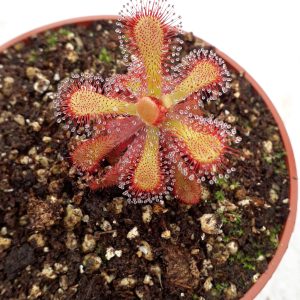
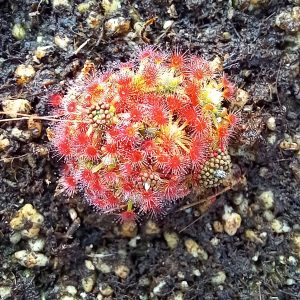
Drosera filiformis
£8.00
Thread leaved sundew – 9cm Pot
- Description
Product Description
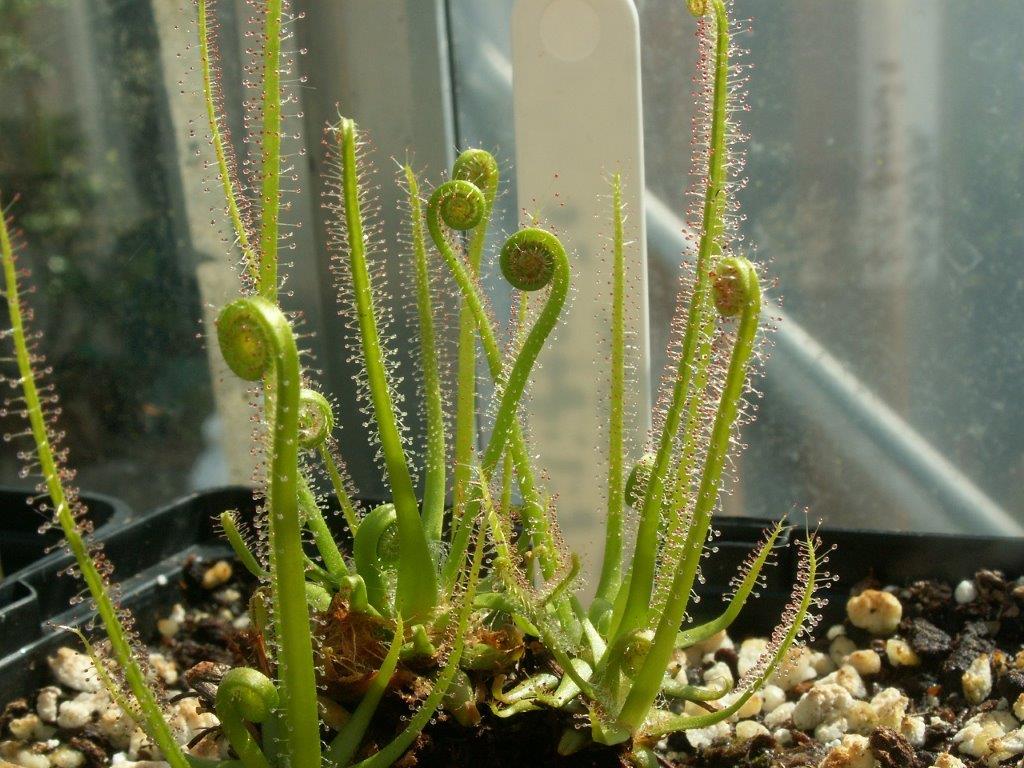
Drosera filiformis, common name the thread-leaved sundew, is a North American sundew which is hardy in our climate. It is known as a temperate sundew, i.e. suitable to our conditions.
Drosera filiformis has long, upright tentacles, which are sticky. Drosera filiformis is found on the Atlantic coast from North Carolina to Nova Scotia along with a few populations in the Florida panhandle
Temperate sundews grow in North America and Europe. They are hardy in our UK climate. Native to the UK are Drosera anglica (the English sundew), Drosera rotundifolia (the round-leaved sundew) and Drosera intermedia (the oblong leaved sundew). Both intermedia and rotundifolia are found in the US, as is Drosera filiformis (the threadleaf sundew)
These sundews require a winter dormancy to survive the winter, when they die back to a resting bud (hibernacula). They need a cold winter.
The native sundews are sun lovers, give them as much sun as possible, preferably outside. They are slow growing, but will produce a carpet of sundews over time.
Drosera filiformis, the North American sundew, will do better in the greenhouse or polytunnel in winter.
Drosera or sundews are a large category of carnivorous plants. To date there are more than 260 different varieties of sundews. They can be found worldwide, on all continents. They stand out with their shiny droplets (nectar), which are used to “glue” their prey to them. We sell many different varieties, some more difficult than others, including three native sundews (Drosera anglica, Drosera intermedia and Drosera rotundofolia). Some are hardy, including the native sundews, others need protection from the frost, and do well on sunny windowsills, heated greenhouse or conservatory. Some are dormant in summer, to protect themselves from drying out
How they feed:
The Sundews produce a sticky substance (known as dew). This (as well as their colour) attracts the insects, who are then trapped in the dew droplets (they are “glued” to the leaf). The trapped insect trying to free itself, stimulates the tentacles to close around it (in most cases). The plant then produces an enzyme to digest the insect.
How to care for your plant:
- We sell a large variety of different sundews with different care requirements, please make sure you research your particular plant on the web.
- They are mainly divided into 9 different categories
- Temperate – they have a winter dormancy to survive winter in our climate (UK)
- Sub-tropical – easy to grow on a sunny windowsill
- Capensis – South African – easy to grow on a sunny windowsill
- Fork leaved sundew – Australian, hardy
- Pygmy – miniature growth, easy to grow
- Tuberous – die back to a tuber in summer
- Queensland sisters – shade loving, high humidity
- South African winter growing sundews – die back to the roots in summer
- Woolly sundews – petiolaris complex – high temperature, high light, excellent terrarium plant
- Rainwater only, sit in water (on a saucer)
- The native plants will have a dormancy period, when they will go underground. Drosera binata and Drosera filiformis will form a winter bud. Some tuberous sundews will be dormant in summer, most non hardy sundews will be dormant in winter.
- During the dormancy period, the main risk to the plant is rotting caused by fungal diseases. It is therefore important to reduce the watering, just keeping the plant damp, but not to let the plant dry out completely.
- Feeding: If you are worried, and your plant is indoors, stick it outside on a sunny day and watch it go to work.